Through disciplined dreaming, effective leaders move forward with boldness and thoughtfulness, with urgency and passion and with a renewed sense of purpose and wonder. ~Josh Linkner

Linkner says that “Businesses have systems and processes for everything, from answering the phone to taking out the trash. Remarkably, most companies have no such system for the one thing that matters most: developing and growing creative capacity.”
You may be thinking that the idea of disciplined and dreaming is an oxymoron. But Josh lays out a series of steps and disciplines that really can expand your creative vision. His suggested Four Most Powerful Techniques to Ignite Sparks of Creativity are especially effective. Below are two examples:
·EdgeStorming
oToss out an idea and then take it to its furthest extreme. To make the list ideas must be outrageously big or small, loud or soft, expensive or cheap. By forcing yourself to the edges you’ll uncover countless fresh and new ideas.
·The Long List
oThe title explains the idea. Identify the problem or challenge and then just begin making a list (as long as possible) of any idea that comes to mind. The key is to not evaluate or assess ideas. Just let them flow and keep going. In Linkner’s description of this technique he suggests (as a group) coming up with 200 possibilities. Two hundred is quite ambitious. However, you will be surprised what you’ll find if your list includes 25-30 ideas. There will no doubt be ideas on your list you never would have thought of had you not tried this method for disciplined dreaming.
Last week I was sitting on an airplane and decided to put some of Josh’s suggested techniques to the test. With nothing other than the ordinary airplane commotion to distract me, I chose the long list technique. I started with the first couple of ideas, which were probably obvious, but then suddenly, to my surprise, other ideas started to come out of nowhere. I continued on and one idea simply kept leading to another. I now have several of these ideas on my to-do list; and they never would have existed had I not tried this technique.
I must admit, I was inspired by a client to pursue this exercise. I had just come from meeting with a firm in DC that develops strategy for policy change at the Federal and State levels. They are ridiculously smart and I was encouraged to hear them talk about the need to schedule thinking time. After all, that’s really what their clients are paying them for – thinking – coming up with innovative and creative strategies for advocacy and policy change. But it’s so rare to hear anyone talk about prioritizing and scheduling time to just think, to be creative.
We are disciplined about so many things: responding to emails, returning calls, scheduling meetings. Yet, the things that actually move us forward, like planning and dreaming, get put on the back burner as secondary activities. Imagine what we could accomplish if we became just as disciplined about dreaming?

Communication is 80% listening & inquiring and 20% speaking. The former must guide the latter. ~Gary Burnison
In my experience, when the topic of leadership and communication comes up, it’s very frequently assumed that by communicating we mean speaking. Actually, speaking is speaking, not necessarily communicating, and according to Gary Burnison, author of The 12 Absolutes of Leadership, speaking comprises only 20% of actual communication.
I recently viewed a speech given by Charles Handy (British management guru) in honor of Peter Drucker and Charles said that he wanted to give the speech so he could learn what he really thought about some of Peter’s theories. Charles said that we learn the most by talking and listening to ourselves. He said that the audience will remember very little of what he said; but he would not only remember what he said, he would learn what he really thinks. So again, why do we think that as leaders, people will learn so much more from us if we talk a lot?
I’ll add one last example from another well-known leadership expert, Jim Collins, author of Good to Great and several other books on leadership. I heard Jim speak a couple of years ago and he provided the audience with Ten To-Do’s to increase our leadership effectiveness. One of the ten was to double our ratio of questions to statements. He said we should “invest more in being interested and less in trying to be interesting.” In other words, ask more and talk less.
Another consultant, Lainie Heneghan, Europe Managing Director for JMW Worldwide (UK) Ltd., provides an example of the impact of listening more and talking less.
Consider this example from the leadership team of a worldwide pharmaceutical company. As they were about to roll out a controversial initiative, they sought help in dealing with the expected employee backlash. They knew from experience that in the face of unpopular change, employees tended to leave their concerns or objections unspoken at first – only to surface later in the form of dissension.
The guidance they were given was simple: to present the plan to a group of key managers and influencers, and to listen to what they had to say until those managers and influencers had nothing further to say. The leadership team members were advised to look at each objection as if it were a ball being thrown at them. Listening was like catching the ball. Throwing it back, or responding, represented not listening.
They held the meeting and stayed true to this listening approach – and emerged with the support of all but one participant. In addition, they gained a better understanding of how they could work with their teams to improve the plan and make it work for everyone. The meeting took a little longer than the typical initiative launch – but it ultimately saved far more time and created much greater possibilities for the initiative’s success.
Imagine if as leaders, we were able to harness our felt need to talk and replaced it with listening and inquiring. For every hour, we listened and inquired for 48 minutes and talked for 12 minutes.
If the need to win is the dominant gene in your “success DNA”—the main reason you’re successful—then winning too much is a genetic mutation that can limit your success. ~Marshall Goldsmith
For all of you competitive types out there, this quote may have both gotten your attention and either confused you or made you a little angry. After all, how could winning too much possibly limit success?
Marshall Goldsmith is someone I’ve admired for a number of years. Marshall is an executive coach and best-selling author whose focus is leadership behavior. He has helped successful leaders achieve positive lasting change in behavior for themselves and their teams.
Here’s how Marshall explains this idea of winning too much.
One big issue of successful leaders is winning too much. If it’s important, we want to win. If it’s meaningful, we want to win. If it’s trivial, we want to win. If it’s not worth it, we still want to win. Why? We like winning.
Winning too much underlies nearly every other behavioral problem. If we argue too much, it’s because we want our view to prevail (we want to win). If we’re guilty of putting down other people, it’s our stealthy way of positioning them beneath us (again, winning). If we ignore people, again it’s about winning—by making them fade away. If we withhold information, it’s to give ourselves an edge over others. If we play favorites, it’s to win over allies and give “our side” an advantage. So many things we do that annoy people stem from needlessly trying to be the alpha male or female in any situation….in other words, the winner.
If you’ve achieved any success, you’re guilty of this every day. When you’re in a meeting at work, you want your opinion to prevail. When you’re arguing your point, you pull out all the stops to come out on top.
And I really appreciate Marshall’s example of how winning too much really can limit our success.
Suppose you want to go to dinner at restaurant X. Your spouse, partner, or friend wants to go to restaurant Y. You have a heated debate. You end up going to restaurant Y. The experience confirms your misgivings. Your reservation is lost, and you have to wait. The service is slow, the drinks weak, and the food bad. You have two options: A: critique the restaurant and smugly point out to your partner that you were right. B: Shut up, eat the food, and enjoy the evening.
When I ask people: “What should you do, and what would you do?” the results are consistent: 75 percent say they would critique the restaurant. Yet they agree they should just shut up and have a good time. If we do a “cost benefit analysis,” we conclude that our relationship with our partner or friend is far more important than winning an argument about where to eat. And yet, the urge to win trumps our common sense. We do the wrong thing, even when we know what we should do.
Imagine how many times a similar scenario happens in your organization – when winning has a much greater cost than the benefit realized from winning. So, maybe winning too much really can limit your success?
Purpose enables hundreds of employees to make thousands of decisions in unison. ~Gary Burnison
Purpose seems so obvious, but is it? I’ve used a TED Talk several times over the past few weeks and this quote reminded me of the point the speaker is driving home. Simon Sinek makes a presentation entitled, “How Great Leaders Inspire Action.” Simon has also authored a book entitled Start with Why.
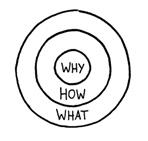
Simon says he’s codified why some organizations are far more innovative and successful than other organizations. He describes a very simple concept that separates these organizations from all others with something he calls the Golden Circle. The circle is divided into three rings. The center ring is why, the middle ring is how, and the outer ring is what. He says that when we communicate most of us begin with describing what we do, followed by how, and on the rare occasion we actually make it to the center circle and explain why we do what we do. The really successful organizations (and leaders) communicate in the reverse order. They begin with why, then explain how, and finally end with what.
The core of why is being able to both identify and articulate your purpose. Why you do what you do, many times stated as beliefs or your reason for existence. For example, below is the description from a prominent Chicago law firm, stated in the typical order of how most leaders and organizations communicate (what, how, why).
We consistently deliver excellence in the most complex and demanding legal matters, both litigation and transactions. No matter what legal challenge is presented, our powerful combination of experience, professionalism and teamwork will achieve the best possible outcome. We do not consider the practice of law a job, but rather a calling to serve clients, the profession and the community.
This is the same description with a little editing and in reverse order (why, how, what).
We believe that the practice of law is a calling to serve clients, the profession and the community. No matter what legal challenge is presented, our powerful combination of experience, professionalism and teamwork will achieve the best possible outcome. We consistently deliver excellence in the most complex and demanding legal matters, both litigation and transactions.
So, honestly, which law firm would you hire, want to work for, or follow their leaders? Most of us would likely choose the second one because, as Simon says, our behaviors are driven by the part of our brain that controls our feelings like trust and loyalty. When we fail to include why in our communication, or if we bury it somewhere behind what and how, we greatly reduce our likelihood to inspire action.
Now, getting back to the quote, imagine an organization where every employee fully understood and embraced its purpose, or why they do what they do. Can you see how thousands of decisions really could be made in unison?
We need to stop spending so much time trying to make the right decisions and instead start spending our time making decisions and then making them right. ~Rory Vaden
Have you ever been stuck in a decision loop? You keep circling back because there are too many options, or the perfect choice isn’t standing out from all of the other options? Or maybe you’re thinking one decision will make your life easier than the other decisions so you want to identify that choice.
You might think that Rory Vaden is suggesting the “quick fix” approach to decision making. Actually, he’s suggesting just the opposite. This quote comes from a book authored by Rory entitled, Take the Stairs. He argues that there is one specific value that is diminishing in modern culture: self-discipline. We’re looking for immediate satisfaction and we live in a shortcut society. So when faced with the option of the stairs or an elevator, 95% of us will take the easier option and forego the stairs. Rory states:
Ask an Olympic athlete. Read Michael Jordan’s autobiography. Listen to what Peyton Manning says is his secret. They all attribute their successes more to having the self-discipline to work harder and push farther in practice than to an innate talent. Sure, people who achieve greatness in any endeavor might be blessed with some natural talent; and sure, timing and luck play a part. But as Malcolm Gladwell demonstrated in his book Outliers, there’s no substitute for hard work—10,000 hours of it, to be exact!
Getting back to decision making, if we’re honest, how many of us make a decision and then expect the outcome to somehow mysteriously materialize, because after all, we made the decision. Many times we spend very little time (due to lack of self-discipline) making our decisions right.
Let me illustrate. I frequently spend hours upon hours with an organization’s leadership developing a strategic plan. Making decision after decision about where the organization intends to head in the next few coming years. Yet, far too frequently, it stops there. The decision is made but then little to no intentional effort is made to make all those decisions right. In other words, they look for the metaphorical elevator and skip the stairs. Dwight D. Eisenhower once said, “Plans are nothing. Planning is everything.” As I see it, plans are essentially a decision but planning is the self-discipline to make it right.
Here we are in mid-March. How many of us started the year with making decisions about what we would change, do, accomplish, achieve, etc. in 2012? How many of us have already abandoned those decisions? Is it because they were not the right decisions? Or is it because we have lost our self-discipline to make them right?
As Rory suggests, imagine what our lives and organizations would look like if we shifted some of our time making right decisions to time spent making our decisions right? What if we had the self-discipline to take the stairs? For Rory, it’s more than a metaphor. He, literally, really does choose to take the stairs as a visible reminder to himself and others that it’s not the quick fix, easy way, or short-cut that leads to success; it’s the self-discipline to make decisions right.