Category Archives: Leadership

Quick summaries of practices to increase leadership capacity and capabilities.

Leaders make art, not work.

Making art means being a linchpin who creates change, makes things happen, makes a difference, is generous – and does all this without permission from the boss.  ~Seth Godin
In his most recent book, Linchpin: Are you indispensable?, Seth Godin suggests that what leaders really do is create art, not work.  Seth says that

Art isn’t only a painting.  Art is anything that’s creative, passionate, and personal.  And great art resonates with the viewer, not only with the creator.  An artist is someone who uses bravery, insight, creativity, and boldness to challenge the status quo.  And an artist takes it personally.  Art is a personal act of courage, something one human does that creates change in another.

Seth’s description reminded me of a modern day artist/leader, Michelle Rhee.  Most of us wouldn’t think of Michelle as an “artist,” but using Seth’s description, she was probably one of the greatest artists of the first decade of the 21st century.  


Michelle was the chancellor of the D.C. public schools who quickly found herself on the cover of TIME magazine.  She knew she was walking into a system in disarray that was clearly not serving the students or providing a quality, or even acceptable, educational experience.  She was bold and courageous.  She didn’t follow the status quo.  She closed an unprecedented number of underperforming schools along with firing a record number of principals.  And yes, she took it personal.  Her own children were in a school where she fired the principal.

Michelle wasn’t “doing work,” she was undoubtedly “creating art.”  Her art, which was first created in 2008, is a masterpiece that many of us continue to admire today.
So why aren’t more leaders artists instead of workers?  Seth tells why.

Here’s the truth you have to wrestle with: the reason that art (writing, engaging, leading, all of it) is valuable is precisely why I can’t tell you how to do it.  If there were a map, there’d be no art, because art is the act of navigating without a map.  Don’t you hate that?  I love that there’s no map.

If you’re willing to navigate without a map, then maybe you’re willing to become an artist of leadership.
Leaders fail.

If failure isn’t an option, than neither is success.  ~Seth Godin
I mentioned in a previous blog that I attended the Global Leadership Summit in August.  Seth Godin was another speaker at this event.  As I’ve talked with other attendees, one of the themes (which I believe was unintentional) that seemed to appear in a number of the speakers’ presentations was the idea of failure.
When you’re going to a “leadership summit” you may not expect, or want, to hear a lot of talk about failure.  You’re a leader after all; shouldn’t the focus be more about success?  But I think Seth was right on point when he said that if failure isn’t an option, than neither is success.  Maybe stated differently, the road to success passes through failure.
A number of years ago I spent a good deal of time making a presentation on a book that I co-authored that focused on workforce, employment and education issues.  In that presentation I talked about failure as a key to learning and how our Western approach to education does not encourage or embrace the idea of failure.  I used Thomas Edison as my example.  Mr. Edison made more than 1,000 attempts before he successfully invented the incandescent light bulb.  In other words, he failed far more than he succeeded and it’s because of those failures that he was able to give us light that would change how we live. 
What intrigued me about the Thomas Edison example is how the audience would react.  They would listen to my presentation – I was fairly good at holding their attention – but when I got to the point about failure, I could see the audience literally lean in to what I was saying.  This caught me off guard.  Really?  Of all the points I was trying to make about employment, jobs, education, being globally competitive, what seemed to really draw them in was failure
Our American culture shuns failure, we lie to hide it, we are embarrassed by it, and we go to extreme measures to cover it up.  When we fail, we immediately jump into the next relationship, the next project, the next acquisition, the next deal, the next hire, etc. to avoid doing the hard work of learning from what went wrong.  In the end, we pay a very high price for our pride by repeating the same failures, again and again.
Imagine a leader who truly embraced failure.  Someone who was transparent when things didn’t work out as planned or hoped.  A leader who took the time not to just say it was a “learning experience” but was disciplined to do the work of learning; a leader who took the time to examine how they, personally, contributed to what didn’t succeed; someone who owned the failure.
The road to success passes through failure; effective leaders are those who accept that fact, embrace it, and lean into it.

Leaders make personal shifts to address the bigger issues.

Everyone has goals; it is the next steps that count.  Ask yourself these questions: ‘For those things to happen, what kind of team do we have to become?  And how do each of us need to change to make that happen?’  ~ Dr. Henry Cloud quoting a confidential client
I’ve been reading a lot of Dr. Henry Cloud’s more recent writing lately and this week’s quote was lifted from his book, Integrity: The Courage to Meet the Demands of Reality. 
Henry suggests that effective leaders not only see the bigger picture, they also realize that they must focus on the bigger issues, which are bigger than themselves.  “The greatest [leaders] are the ones who have not sought greatness, but served greatly the causes, values, and missions that were much bigger than them.”  Henry quotes Thomas Merton who said, “To consider persons and events and situations only in the light of their effect upon myself is to live on the doorstep of hell.”
Henry’s client, who I’ve quoted this week, is someone who runs the western United States for one of the big telecommunications companies.  He takes his team of direct reports on a retreat every year and they begin with a few questions.  The first is, ‘What would we like to see happen in the next year?’  This gets them to their vision, and the goals.  In this particular year, their goal was admittedly audacious.  They wanted to do so well that the whole company would stop and want to know how they did it.  But, then they asked themselves these questions: ‘For those things to happen, what kind of team do we have to become?  And how do each of us need to change to make that happen?’ 

They went to work making shifts in themselves focusing on their audacious goal and they did so well that the CEO flew out to find out what they did that was different than everyone else, and how everyone could learn from it.  They achieved their vision!

Henry believes that their vision demanded that these individuals make shifts in their practices to meet the demands of reality.  They did not ask reality to shift, but they did the shifting. 

If you’ve had a hard time identifying what you truly value, I think this can be a good test to help make that determination.  I’ve found that if I believe something is really important or bigger than me (like their audacious goal),  I’m much more willing to shift my thinking, or give up getting things my way because I’m so focused on the bigger issue.  Ironically, if I’m fighting so hard to have it my way and am unwilling to shift then I’m probably focusing more on myself than I’m willing to admit.  And I most likely haven’t asked how I need to change in order to address the bigger issue.  As this week’s title states, “Leaders make personal shifts to address the bigger issues.”

Leaders deal with challenging people.

Leaders know that their organization’s future is tied to its people.  They are not only voracious about attracting and retaining fantastic people, they have a plan for dealing with challenging people.  ~Bill Hybels, 2011 Global Leadership Summit

This week I’m continuing with Bill Hybel’s presentation from the Global Leadership Summit on August 11, 2011.  Another of the Five Critical Questions leaders must ask was question two: “What is your plan for dealing with challenging people”?

Bill stressed the importance of the leadership team having a collective point of view as to how they would deal with challenging people, and he was very specific.  I think to the surprise of many in the audience.

Bill said that challenging people typically fall into three different categories.

Fantastic Fred.  These are the people who may be quite competent at their job, skill or task, maybe even fantastic.  The challenge is their attitude.  They have a bad attitude and they are spreading that bad attitude to others in the organization.  So, how much time do they give the Fantastic Freds at Willow Creek to get things turned around?  30 days.  They start the conversation immediately, and then they need to see change in 30 days, and if not, Fantastic Fred is asked to find an organization that might be a better fit.

Underperformers.  In some regards this is the easiest category because the underperformers are typically obvious, although not always to the underperformer.  These folks are given a clear explanation of how they are underperforming and what acceptable performance would look like.  Then they have 3 months (no more) to show that they can meet the expectations of their position.

Those lacking talent elasticity.  This is the most difficult of the three categories because these challenging people are good and hard-working; they may have been with the organization for many years.  Unfortunately, the growth of the organization now requires a greater capacity than what they appear to have; in other words, they don’t have the talent elasticity to grow with the organization.  This group is given the longest amount of time to either find a different place within the organization or bring their skills and performance up to the level the organization now requires.  They are given 6-12 months.

Why should you have a specific plan to deal with challenging people?  If you don’t, you’ll discourage your best performers and run the risk of losing them.  One commonality among the three categories of challenging people is they aren’t really happy people.  Maintaining status quo isn’t going to change that.

What are you naming, facing and resolving?

Leaders name, face and resolve the problems that exist in their organizations.  ~Bill Hybels, 2011 Global Leadership Summit
In 1995 the Willow Creek Association (founded by Bill Hybels) launched the first Global Leadership Summit.  Today, well over 100,000 leaders attend the annual event at over 185 locations and in more than 70 countries.  As is custom, Bill Hybels opened this year’s event that took place last week with a thoughtful, insightful and practical presentation of Five Critical Questions a leader must ask.
The quote for this week is one of the five critical questions Bill posed to the massive audience of leaders.  “Are you naming, facing and resolving the problems that exist in your organization”?
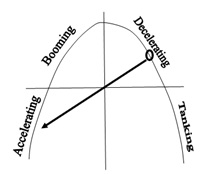
Bill included in his presentation a lifecycle diagram to help identify, or “name” the problems in our organizations.  Below is my attempt to recreate the diagram so please forgive my crude drawing, but the concept is what matters.  Bill told us to go through all of our products/programs/services, etc. and place them on the diagram.  Are they accelerating, booming, decelerating or are they tanking?  When something begins to decelerate it’s getting tired, new ideas need to be infused to move it back to accelerating and avoid tanking.  In other words, address the problem.
I would add one possibility that Bill did not mention so I’m inserting my own opinion here.  I don’t think everything that begins to decelerate should be moved back to being accelerated.  Sometimes ideas, programs, products, services, etc. have truly served their purpose and it may be time to end it before more time and resources are invested while it’s tanking.
Most important, naming and facing problems is the first step to resolution.  All organizations have an elephant or two in the room.  Are we ready to name them and face them?