Monthly Archives: July 2016

Wanted: Real Leaders

There’s a difference between leading and rallying. We can rally people if we stoke their fears. Leadership is about inspiring people with hope. ~Simon Sinek

If I think aimagesbout leadership within the context of political party conventions, it makes my head hurt. What I see, from all sides, just doesn’t feel a lot like leadership. I feel like I’m being persuaded to vote based upon what they believe I should fear, instead of what inspires me to hope for an optimistic future.

I don’t know about you, but I need a respite from all this “rallying” and a reminder of what leadership is really about. Here are a few quotes that have helped me to refocus my perspective on real leadership.

  • Pride makes us artificial and humility makes us real. ~Thomas Merton
  • Humility, that low, sweet root, from which all heavenly virtues shoot. ~Thomas Moore
  • Humility is nothing but truth, and pride is nothing but lying. ~St. Vincent de Paul
  • The difference between a good leader and a great leader is humility. ~Jim Collins
  • Great leaders don’t need to act tough. Their confidence and humility serve to underscore their toughness. ~Simon Sinek
  • The challenge of leadership is to be strong but not rude; be kind but not weak; be bold but not bully; be thoughtful but not lazy; be humble but not timid; be proud but not arrogant; have humor but without folly. ~Jim Rohn
  • To possess self-confidence and humility at the same time is called maturity. ~Jack Welch
  • Humility is a great quality of leadership which derives respect and not just fear or hatred. ~Yousef Manayyer
  • A great leader needs to love and respect people, and he needs to be comfortable with himself and with the world. He also needs to be able to forgive himself and others. In other words, a leader needs grace. ~Leo Hindery, Jr.

After a few more months of intense name-calling, fear-based ads, and simply rude behavior, I’ll hope for real leadership to emerge somewhere in this nation of ours.
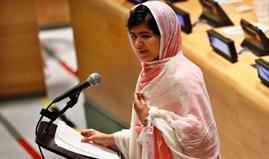

Transforming Pain and Suffering into Leadership

The terrorists thought that they would change our aims and stop our ambitions but nothing changed in my life except this: Weakness, fear and hopelessness died.  Strength, power and courage was born.  ~Malala Yousafzai

MalalaPain, suffering, disappointment, and life gone wrong; any of these sound familiar?  We will all encounter moments or seasons of pain and disappointment.  But we can choose how to respond to that pain and suffering.  It can lead to devastation, anger, and despair; or it can lead to transformation, hope, and courage.  Many great leaders have been born out of horrific pain and sacrifice.

Malala Yousafzai, the 16-year-old Pakistani girl who was brutally attacked on her way home from school – shot in the head at point-blank range by the Taliban.  ABC World News reported back in 2013, “One year later, the shot heard round the world has given birth to a movement of change – a movement to educate girls, and the little girl from Swat Valley in Pakistan has become an international symbol of courage and hope.”

The fact that Malala survived her attack is miraculous.  But I think what really transfixed us, was Malala’s response to the attack and her attackers.  While speaking to the UN she said, “They thought that the bullets would silence us, but they failed.  And then, out of that silence, came thousands of voices.”  In an interview with Jon Stewart, Malala stated, “I don’t want revenge on the Taliban, I want education for sons and daughters of the Taliban.”  It was the transformation of pain that very quickly catapulted Malala into the global spotlight.

Philip Yancey writes about suffering in his recent book, The Question that Never Goes Away.  He quotes Victor Frankl who said, “Despair is suffering without meaning.”  Later in the book Yancey says that “we get not a remedy for suffering but a use for it, a pattern of meaning.”  He quotes Terry Waite, who said after being released from four years’ captivity as a hostage in Lebanon, “I have been determined in captivity, and still am determined, to convert this experience into something that will be useful and good for other people.  I think that’s the best way to approach suffering.”

I realize that most of us have not suffered the extreme circumstances of Malala, Victor Frankl, or Terry Waite.  But we’ve all dealt with our own pain and suffering.  What’s the use for our suffering?  What’s the pattern of meaning?  I believe the leadership we truly desire to follow is from the people who find a pattern of meaning amidst their pain and suffering.  They give us hope, they personify courage; we believe that if we can grab hold of even a fraction of their strength everything will be okay.

What’s the pattern of meaning for your suffering?  Has your loss created a leader in you?

Leaders are products of their decisions.

I am not a product of my circumstances. I am a product of my decisions. ~Stephen Covey

fork in roadEver felt stuck, boxed-in, or maybe like everything was happening to you and you had no control? We’ve all had those moments, some lasted longer than others. Someone who lives from the perspective of being a product of their decisions, not their circumstances, is a leader.

Numerous psychologists have written about the critical acknowledgment of our ability, and freedom, to make decisions. One of those psychologists is author and Holocaust survivor, Viktor Frankl. Frankl said, “Between stimulus and response there is a space. In that space is our power to choose our response. In our response lies our growth and our freedom.” He also said, “Everything can be taken from a man but one thing: the last of the human freedoms—to choose one’s attitude in any given set of circumstances, to choose one’s own way.” The key word in these quotes is to choose, and by choosing we are making decisions.

Another psychologist, Dr. Caroline Leaf in Switch on Your Brain, said, “One brain generates more energy (electrical impulses) in one day than all the cell phones on the planet (quoting Joe Dispaneza). So we have the power to make changes; we do not have a spirit of fear, but of love, power, and a sound mind.”

A former Navy SEAL, Brent Gleeson identified seven tips for being a more decisive leader, to face the tough decisions (be a product of his decisions, not a product of his circumstances).

  • In the absence of orders, take charge.
  • Stop avoiding those difficult conversations.
  • Make that decision you should have made months ago.
  • Know that most problems are never as bad as they initially seem.
  • Actively decide to be a better leader.
  • Remember that you are not alone.
  • Make a decision to be positive, no matter what.

Dr. Leaf tells us, “This is the incredible power God has given us: to be able to think and choose and create reality.”

What decisions are you putting off? What decisions do you need to make this week? What decisions could make you a more impactful leader? In your leadership roles, how will you use the incredible power God has given you, to create reality?

Leadership & Freedom

For to be free is not merely to cast off one’s chains, but to live in a way that respects and enhances the freedom of others. ~Nelson Mandela

flag and fireworksThis year more than most, violence, hate, and anger, creates a dark cloud that hangs over our celebration of independence and freedom. Don’t get me wrong, I’m incredibly grateful to live in this country. It just feels like we’ve not embraced, but moved farther from the vision of our forefathers. When I read Thomas Jefferson’s notable quote, “We hold these truths to be self-evident: that all men are created equal; that they are endowed by their Creator with certain unalienable rights: that among these are life, liberty, and the pursuit of happiness,” I wonder if we’re no longer really listening to those words.

As we celebrate our freedom, I think about conversations I’ve had with people of various backgrounds and cultures over the past few years. I’m reminded of the varying definitions of “freedom” I’ve heard. Many of those definitions seem to be focused on Webster’s definition of freedom: the power to determine action without restraint; exemption from external control, interference, regulation.

It’s hard for me to think of any leader more qualified than Nelson Mandela to teach us about the word freedom. He knew all too well what it was like to be stripped of freedom, to be literally behind bars for more than a quarter of a century.

For Mandela, freedom goes well beyond Webster’s definition, it’s not merely to cast off one’s chains. It is to live in a way that respects and enhances the freedom of others.

Now that’s a leadership mantra! “To live [and lead] in a way that respects and enhances the freedom of others.”

Let’s celebrate our freedom this week, the Mandela way. Imagine if all leaders throughout this country stood for a definition of freedom that respected and enhanced the freedom of others. Then maybe we truly would be the United States.